
What are the different types of Andon? How do you set them up in your production facility?
Originally a simple visual and audible alert system triggered by an operator to signal an incident or malfunction, the andon has evolved considerably in recent years, with innovations in alert devices that are now digital, offering greater flexibility and automatically generating data useful for continuous improvement.
As a result, e-Andon, or digital Andon, remains more relevant than ever in industry, helping to boost productivity and optimize all production processes. What type of e-Andon should I set up? How do you go about it? What are the concrete benefits? Our answers.
6 main types of Andon: how to choose the most appropriate?
A system of visual and/or audible alerts to reveal anomalies at a glance, the Andon can be applied to virtually any industrial process. Andons are generally distinguished:
- “simple” (or “self-sufficient”): these Andon systems require devices to launch alerts, designated “recipients” and a few qualification rules to clarify the nature of the problem being reported,
- “advanced”: more complex to set up than the previous ones, they often require prior experience with a simple Andon. But they also guarantee greater productivity gains!
The Andon operator
This alert system is triggered by the operator, from his workstation, to report an incident (whether blocking or not): breakdown, stoppage, accident, lack of part, quality problem… and receive rapid assistance.
Operator e-Andon: what are the benefits for your plant?
Some time after the implementation of an operator Andon, we notice :
- greater reactivity in the event of a problem: the operator can immediately raise the alarm and receive assistance from support services, without leaving his workstation,
- more precise alerts: Andon systems let you know where an incident has occurred, and its nature or degree of criticality,
- optimal information flow: operators know in real time whether their call has been received, taken into account, and whether or not the response is underway.
How to set up an e-Andon operator
To deploy an Andon operator alert system quickly, you need :
- Identify the types of breakdowns and incidents that will trigger an Andon call and enable it to be qualified: machine incident, accident, insufficient stock of parts, etc.
- List alert recipients by shift:
- level 1 (workshop leader)
- level 2 (factory leader)
- support services (maintenance)
- Deduce the type of hardware (remote controls, tablets, screens, etc.) needed to operate the system optimally.
Andon supply
The Andon supply or Andon forklift operator is a special form of Andon operator dedicated to internal factory logistics issues: triggering the supply of parts, calling a forklift operator, managing assembly kits…
The aim? To facilitate flow management and avoid any disruptions, using manual alerts to trigger replenishment.
What are the benefits of e-Procurement?
By putting the operator in “command” of his stocks, e-Andon procurement enables :
- better compliance with production rates,
- rationalization of forklift truck operators’ rounds, and optimization of logistics resources according to activity,
- an invaluable source of learning for more efficient production management.
Implementing e-Andon procurement: the methodology
To streamline your internal logistics with e-Andon operator, you must first :
- Établir le référentiel des pièces concernées par votre futur process de réassort rapide (celles dont l’absence risque de bloquer l’opérateur et donc la ligne de production)
- Définir pour ces pièces les niveaux de stock (maximum/correct/insuffisant…) qui vont conduire l’opérateur à déclencher un appel Andon
- Identifier les destinataires de ces appels :
- au niveau 1 (ressource logistique),
- au niveau 2 (manager logistique en cas de retard).
The e-Andon machine: what are the benefits?
By setting up monitoring parameters to implement e-Andon machine :
- you ensure optimum responsiveness from your teams: no more human “filter”, alerts are the result of real-time machine data readings, and no longer (or no longer only) the result of episodic inspection rounds or operator alerts,
- you encourage the implementation of a predictive maintenance system, as your support services gather valuable information (frequency of breakdowns, origin of problems, resolution times, etc.) to anticipate problems, and more rapidly implement action plans to correct recurring faults, breakdowns and incidents… and thus make production lines more reliable.
Setting up an e-Andon machine: what are the prerequisites?
To implement this automated alert system, you need to have the following prerequisites:
- Your machine fleet must be equipped with sensors or automated monitoring systems.
- The signals picked up enable pre-qualification of the type of incident: breakdown, part wear, inconsistent metrics, etc.
- You and your teams have drawn up a call-out and escalation plan defining who will intervene when in the event of an alert.
Quality Andon
When a drift in quality is observed, an Andon quality alert system makes it possible to :
- alert the leaders and support departments concerned,
- process and monitor reactive actions,
- record and qualify qualityincidents to feed a continuous improvement strategy.
What are the benefits of quality e-Andons?
With this type of Andon, you ensure :
- more proactive quality management, with clear processes for dealing with deviations,
- minimize the cost of non-quality, with the possibility of reacting as soon as a drift is detected on the production lines, instead of restarting the production of a complete batch.
Implementing e-Andon quality: what are the prerequisites?
To implement this Andon alert system, you need to have :
- a quality review system close to production,
- clearly documented checklists and control points,
- alert triggering and escalation rules known to all concerned.
The Andon flowboard
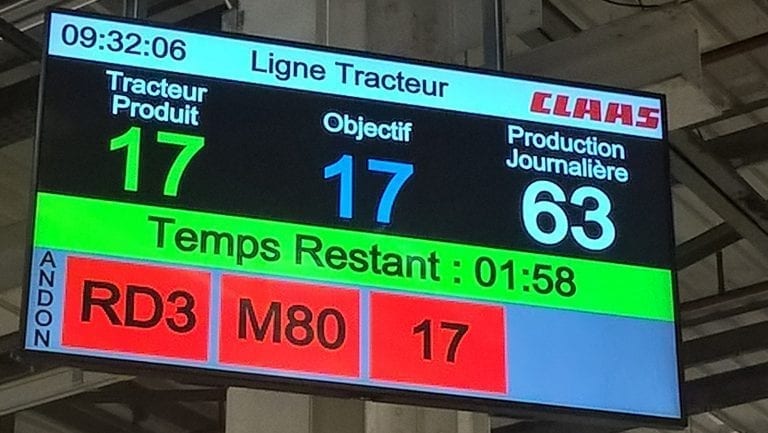
Also known as Andon Advance-Delay or Yo-I-Don, this form of Andonalerts teams to any drift in activity monitoring, with real-time calculation of advance or delay in relation to a pre-established “standard” rate.
The Andon flowboard is therefore particularly well suited to production units:
- with operators who have the same amount of time to complete their task, before handing over the part to the next operator,
- where synchronization of different workstations is key.
L’e-Andon flowboard: what are the benefits?
This advanced form of Andon takes the operational excellence of a production unit up a notch, with :
- better visibility of activity: linked to takt time indicators, the progress of each workstation is visible, enabling the leader to immediately identify those that are experiencing problems,
- better-informed teams, with greater peace of mind and greater motivation,
- a significant gain in responsiveness, with incident resolution times divided by 2 or even 3,
- a clear gain in productivity: +10 to +20% of the production unit’s OEE.
Setting up the e-Andon flowboard: how to proceed?
To set up an e-Andon flowboard system for monitoring activity in advance-delay mode, you need to :
- Define a clear notion of the objective (nominal time and takt-time), at production line level, then station by station,
- Install real-time activity monitoring devices (task or cycle completion signals at each station).
The design of a real-time flowboard is therefore an essential prerequisite for the creation of your future advance-delay warning system.
Andon piloting
With Andon piloting, we move from an alert/response system to one where the Andon becomes a real tool for piloting production in real time. Thanks to a connection with the company’s information system, all activity flows can be synchronized:
- supplies are updated in real time, and stock alerts are set to avoid stock-outs,
- forklift operators are automatically assigned to a task according to their availability,
- production progress is monitored using objective indicators.
What are the benefits of e-Andon piloting?
e-Andon piloting makes it possible to supply production lines in real time, to avoid shortages (or, on the contrary, bottlenecks), and to control production as closely as possible to demand, with advanced stocks at the start of the line at a minimum level.
The result?
- unrivalled responsiveness, with incident resolution times divided by 3 or 4,
- an OEE increased by 15%, as observed by our customers.
Implementing e-Andon piloting: what are the prerequisites?
The “ultimate” stage of digital Andon, e-Andon piloting is rarely implemented at once. Beforehand, you need to have installed and mastered :
- e-Andon operator and e-Andon procurement, to control production and internal logistics flows.
- e-Andon flowboard, for an actionable lead-lag reference system
How do you design an efficient Andon system?
1. Choosing the right signals
In an Andon alert system, we distinguish between :
- simple” signals: a maximum of 3 to 4 types of incident to be reported, with little detail on the causes (e.g. station stoppage, accident, faulty workmanship),
- complex” signals: the operator or supervisor is asked to provide a greater level of detail on the problem encountered (missing part number, nature of the breakdown or blockage, etc.) to facilitate the work of the intervention teams.
In practical terms, you’ll need to draw up a precise list of :
- the facts or indicators that should lead an operator, a quality supervisor, or an autonomous machine to trigger an alert,
- the level of detail required for this alert, from the very simple (sufficient if it’s a matter of having a leader move to the area) to the very precise (description of the fault, reference of the missing part…).
2. Choosing the right hardware
To get your Andon system up and running, you’ll need :
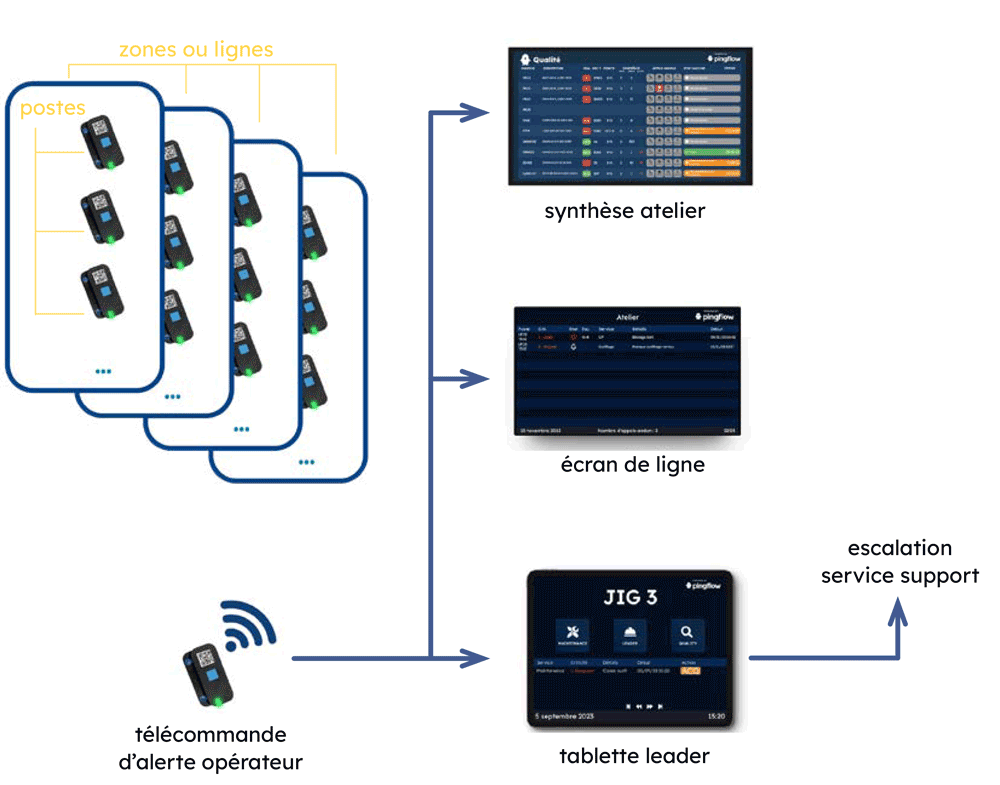
- devices dedicated to Andon calls: for “simple” alerts, traditional light columns or audible alarms are now replaced by radio remote controls; to code calls and enter information (complex signals), tablets or operator consoles are now preferred, enabling Andon forms to be filled in easily,
- devices for receiving these alerts: generally, the cell phones of workshop leaders, and the computers of support service managers,
- devices for displaying alerts in progress: line screens or summary screens in workshops and offices, etc.
3. Determining escalation rules
The strength of a well-designed Andon system lies in its ability to “cover” as many possible scenarios as possible when the Andon alert is launched:
- shift by shift, who should be notified first?
- after how long should this person be contacted again?
- to whom should the alert be forwarded in the event of a non-response at level 1? level 2? etc.
Here’s what a precise “escalation plan” might look like:
| Shift | 1st call | 2nd call | Escalation 1 | Escalation 2 |
| 8am - 4pm | 📲 Leader | 5 min. | 📲 N+1 Leader | 📲 Quality responsable |
| 4pm - 00am | 📲 Leader | 5 min. | 📲 N+1 Leader | 📲 Quality responsable |
| 00am - 08am | 📲 Leader | 5 min. | 📲 On-call management | 📲 Safety/quality on-call duty |
4. Involve the players
This applies to Andon as it does to any lean management system that will change work processes and habits: the No. 1 key to success lies in your ability to involve the teams concerned.
- When you choose the initial scope of your Andon project (a specific line, the whole workshop…),
- When you draw up the list of situations that trigger an Andon alert,
- When you deploy Andon and carry out initial assessments of the system’s performance: are teams saving time? After the first few days, are alerts launched appropriately? What can be improved to make it easier for teams to adopt the system?
How can we capitalize on Andon for continuous improvement?
An Andon system generates immediate benefits:
- greater reactivity in detecting and resolving incidents,
- greater operational efficiency (less non-quality, less line downtime, etc.)
- increased productivity, from 5 to 15% or more of the synthetic yield rate when the system is fully operational.
These are reasons enough to consider deploying Andon! But they’re not the only ones… Digital Andon is also a way of having a permanent“snapshot” of the business, on which to base your continuous improvement initiatives.
Make the data talk
Whatever Andon digital system you implement, you generate data :
- on the incidents encountered: their frequency and recurrence, depending on the type of problem, workstation, line or product…,
- on your resolution process: reactivity and resolution times,
- on production itself: downtime, effective line working time, optimum and actual production rates…
These are all valuable clues to help you see more clearly how to optimize your processes and move towards operational excellence… if you use them:
- by feeding an incident database shared with the teams concerned (quality, maintenance, production),
- by synchronizing them with your business solutions (e.g. ERP)
- by translating them into prioritized action plans.
Andon, what’s next?
Once you’ve set up and stabilized an initial Andon system, what’s the next step in achieving further productivity gains in your production unit?
Broadly speaking, there are two possible paths:
- Generalize and amplify Andon, by multiplying use cases: cover other production units with the same type of Andon, or add a new Andon system as an “overlay” (Andon operator, then Andon supply, then Andon piloting, as our customer Chantiers de l’Atlantique did in stages). In this way, you can capitalize on the experience you’ve gained to deploy future Andons more rapidly.
- Complement your Andon alert system with other lean manufacturing tools: team ritual animation (AIC), flowboard (production management). Pursue digitalization work to move towards Industry 4.0.