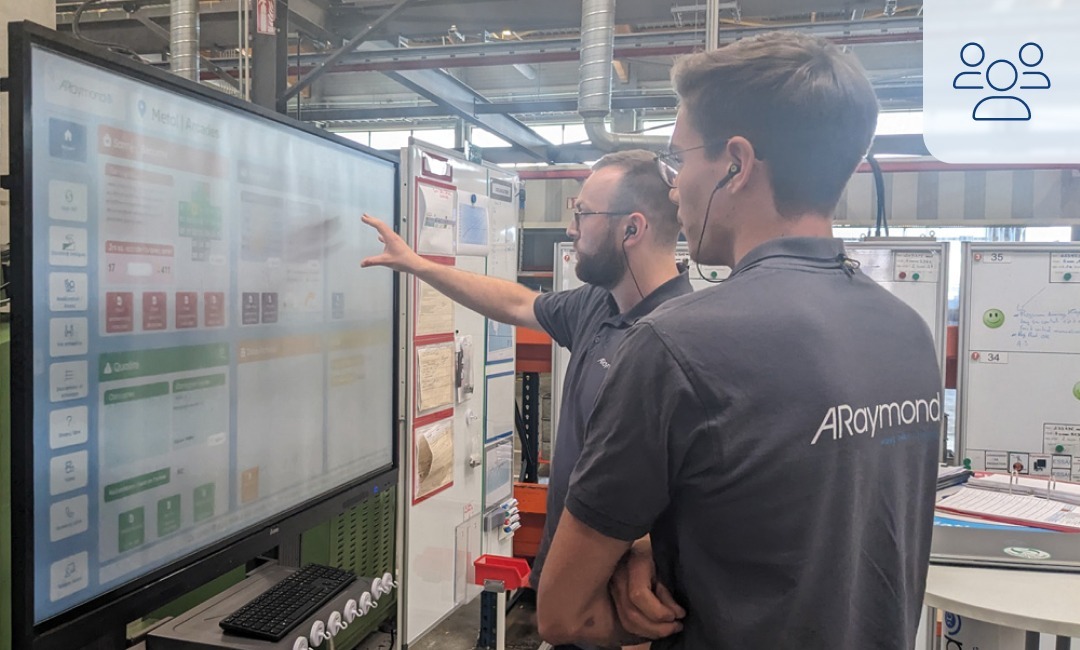
Starting from the needs of its teams, while standardizing as many visual management best practices as possible: discover how ARaymond is engaging its employees worldwide in the digitalization of its factories.
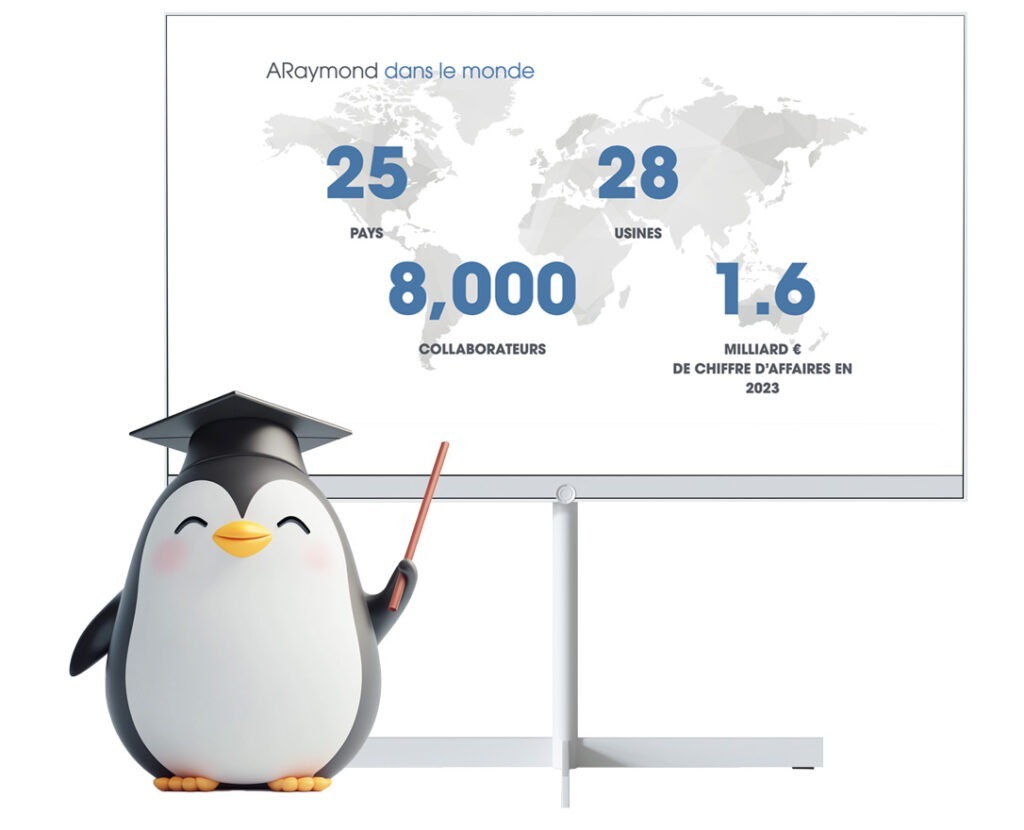
ARaymond is a global leader in fastening, assembly, and fluid handling solutions for the automotive industry. Over the years, the group has diversified into other sectors as well, including solar energy, pharmaceuticals, construction, and horticulture. With more than 8,000 employees across 28 factories worldwide, the company has a long tradition of innovation since its founding in 1865—its implementation of digital visual management is a strong example of that legacy.
Short Interval Management (SIM): a cornerstone practice in ARaymond’s shopfloor operations
Before this journey began, ARaymond identified the need to optimize its team animation rituals (AIC). Both at management level and on the shopfloor, “there was a strong expectation to make communication easier, and to quickly and efficiently share relevant information,” explains Cathy Tondu, who was appointed by the group to lead the project of digitizing these rituals.
Rituals: a necessity in the group’s corporate culture
Optimizing AIC through digitalization is all the more important in a group like ARaymond, which places team autonomy and empowerment at the heart of its approach. Formalized in 2012 (but part of the company’s mindset since its origins), “servant leadership” is a cornerstone of ARaymond’s corporate culture.
The idea? The manager serves the team, not the other way around. Their role is to give team members the tools to make autonomous decisions—to be supported, heard, guided, and empowered. In this context, effective and participatory team rituals are absolutely essential!
A digitalization project to be restarted from scratch
At the end of 2021, Walter Bongibault, ARaymond’s Director of Digital Transformation, tasked Cathy Tondu with finding a digital visual management solution that would take the team animation rituals (AIC) to the next level. The starting point was the Technisud factory (Grenoble), where two digital AIC initiatives had been launched but then halted due to the Covid-19 pandemic. Cathy’s roadmap? “Analyze what was tested in these initial trials, decide what to keep and what to change, and reignite momentum around this project.”
Choosing Pingflow: for support and flexibility
It was therefore logical to restart the project in the same factory, with two competing solutions evaluated in parallel. After a few weeks of testing, Pingflow emerged as the winner for two main reasons: the solution’s flexibility and the support provided to the teams.
Pingflow Support: a deep understanding of needs
“What was greatly appreciated was that the Pingflow project team took the time to visit us, understand our work environment, and build a relationship of trust with the users.”
Cathy Tondu
“This is very important, because when you embark on designing a tool like this, you are, in a way, translating the company’s culture.”
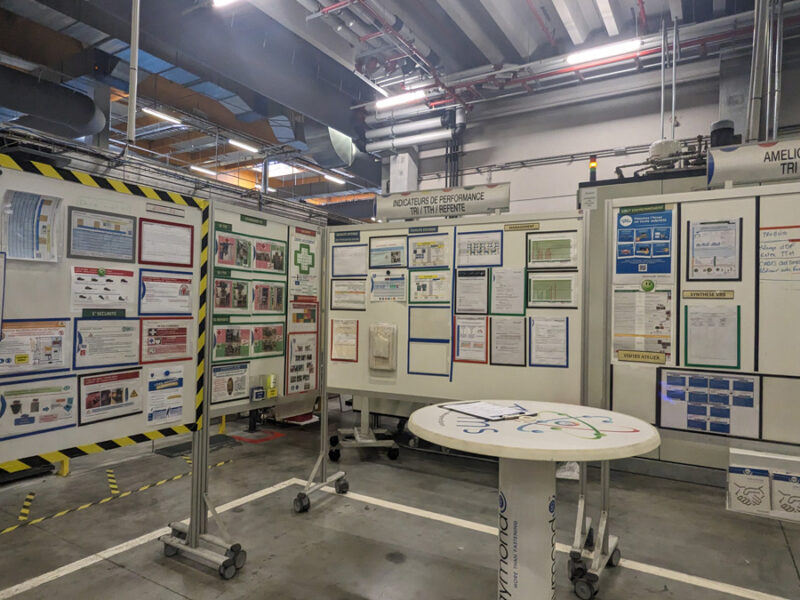
All our projects follow the same approach: to develop a digital visual management project, you have to start on the ground, with the needs of the people who will use it every day. Understand how they work, and identify the key information that is essential for them to accomplish their tasks.
An approach that involves collaborative workshops, addressing pain points, and managing a multidisciplinary project team.
“In our case, project groups included the workshop manager/leader, operators, and setters, but also support services (maintenance, health and safety…), the RAYNET teams (internal IT support, DATA teams…), and what we call ATOMS coordinators (for ARaymond Total Operations Management System), who are essentially responsible for operational excellence and continuous improvement.”
Cathy Tondu
The Pingflow Solution: a scalable tool to support growing usage
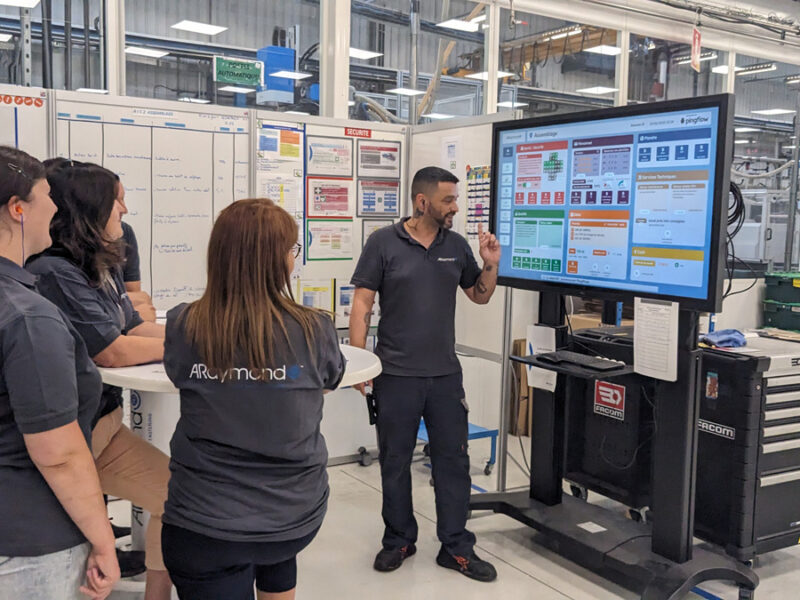
The other aspect of this test that allowed us to confirm our choice of solution,” continues Cathy Tondu, “was Pingflow’s ability to support us during deployments, not only in France but also internationally. The Pingflow solution allowed us to start with relatively simple wallboards, and then iterate by adding more advanced features as the teams became familiar with the tool. With the assurance that they would be trained and increasingly capable of working independently.
Implementing a digital visual management solution indeed requires mastering change management: engaging and involving the teams concerned is essential, and allowing them to start ‘simple’ and progress at their own pace is just as important.
Successfully Deploying a Digital Visual Management Solution
Pitfalls to avoid, key success factors, best practices… In this webinar, discover Cathy Tondu’s insights on deploying Pingflow across ARaymond’s factories.
A phased deployment
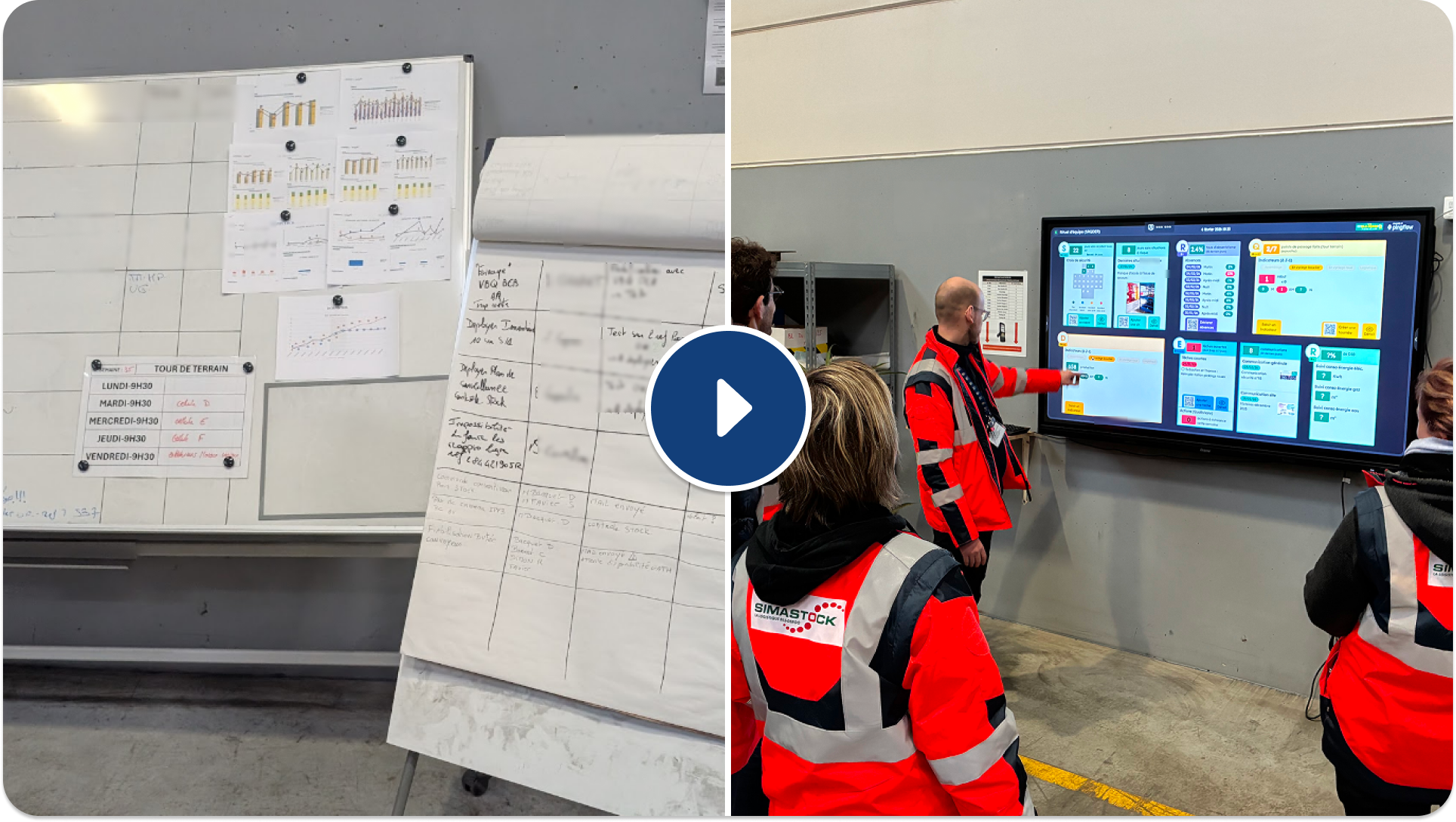
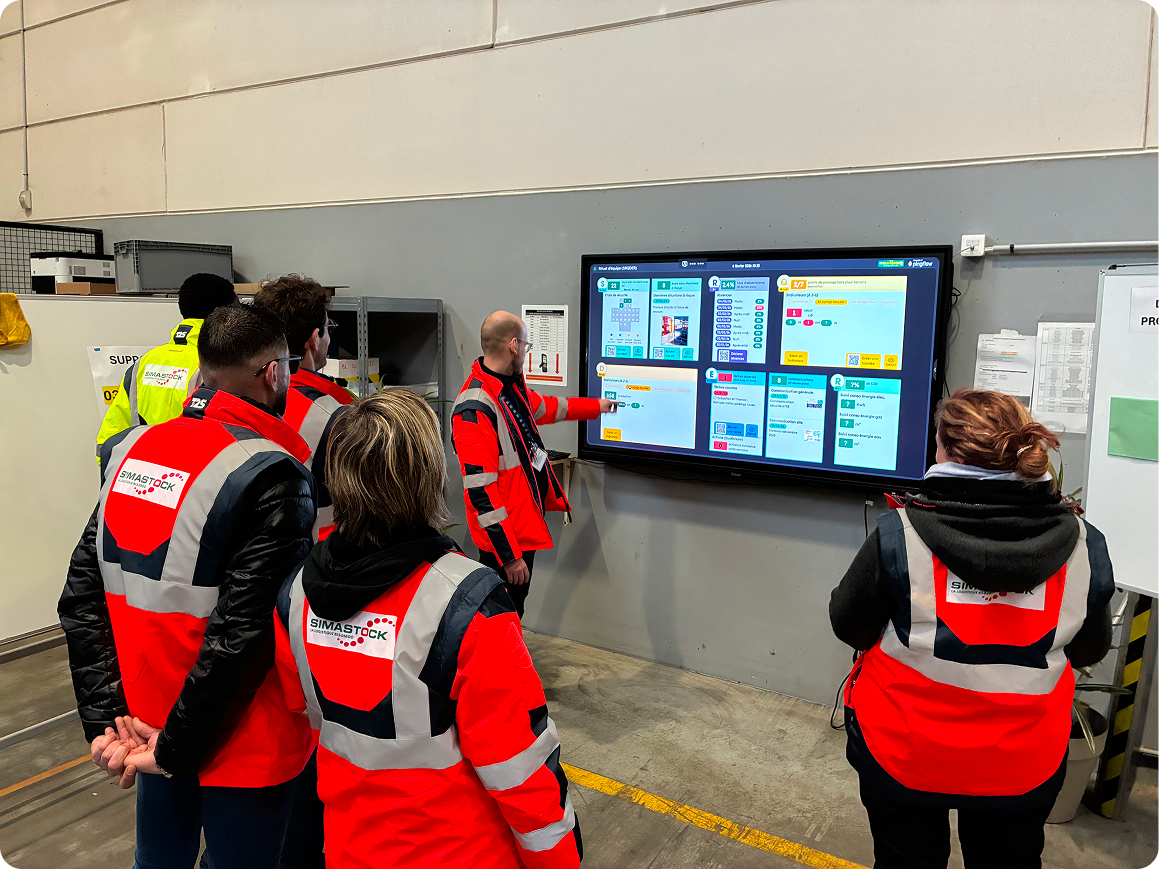
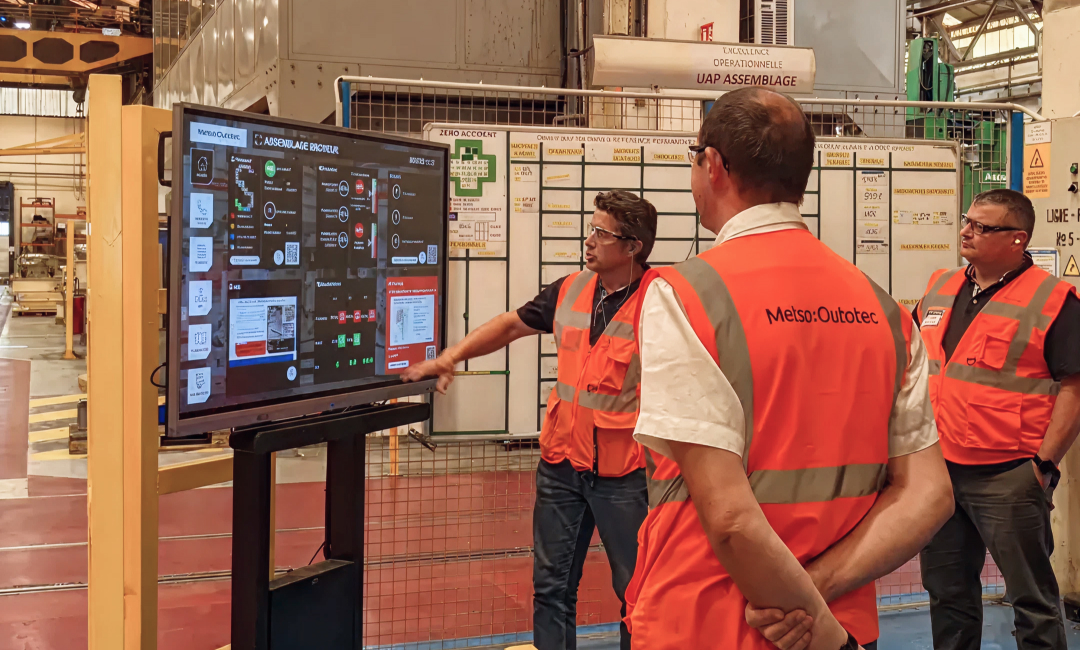
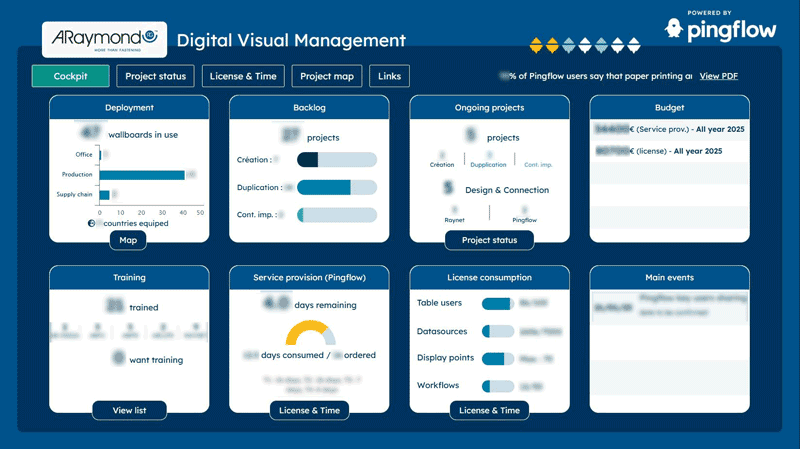
Three years after the installation of the first wallboards (the screens used during team animation rituals), around 50 wallboards are now in use across the factories. The deployment was carried out using a well-established methodology that maximizes team engagement. Cathy Tondu emphasizes that digital AIC did not revolutionize the existing rituals but strengthened them and provided new opportunities for team autonomy.
Getting Started: the user experience approach to ease adoption
The first wallboard implemented in a new ARaymond entity is always an opportunity for extensive on-the-ground listening and design thinking. The goal is to :
- Identify the needs of all personas (operators, leaders, support services)
- Understand their pain points
- Assess the team’s level of maturity and therefore its ability to adopt the future wallboard
Walter Bongibault notes that it is this approach of gathering needs from the field (which helped specify the necessary data and indicators) that enabled rapid adoption.
"Thanks to this UX/UI work and the solution’s customizable interface, the teams quickly took ownership of their wallboards."
Deployment: iterate, then converge
This UX approach does not stop at the delivery of a wallboard “V1.” After using the first wallboard in real conditions, users are invited to:
- Provide their feedback and suggestions for improvement
- Get involved in adjusting the wallboard over time
- Share their progress and ideas during usage reviews, benefiting the entire ARaymond network
"The goal is to have the same wallboard for AICs, with only minor variations within a single entity, explains Cathy Tondu. But this isn’t achieved on the first try, and that’s one of Pingflow’s strengths: we were able to proceed in stages, first designing part of it with one team, then another, and finally creating a final version where we converge, keeping the best of both designs by leveraging collective intelligence."
Scaling Up: a library of use cases to inspire new projects
With three years of hindsight, this process is now well established. Cathy Tondu notes that a wallboard today is 80% replication of what has already been successfully implemented elsewhere, and 20% customization to fit local needs and cultural specifics.
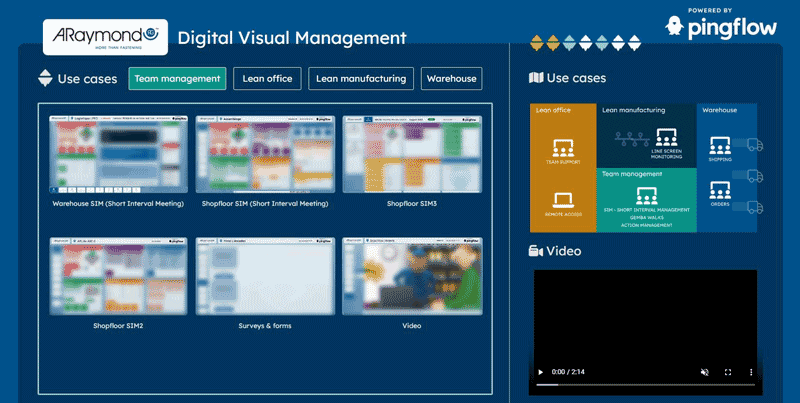
To clearly demonstrate the possibilities and spark interest in entities that have not yet adopted digital visual management, ARaymond created a “showroom” of existing wallboards. This is an effective tool to help project leaders envision their own implementations, distinguishing “standard” use cases (QHSE communication, production indicators, etc.) from those that can be deployed later, such as interactive forms for reporting hazardous situations or checklists for gemba walks.
Digital AIC at ARaymond: rapid and agile progress
Enhancement: wallboards connected to data
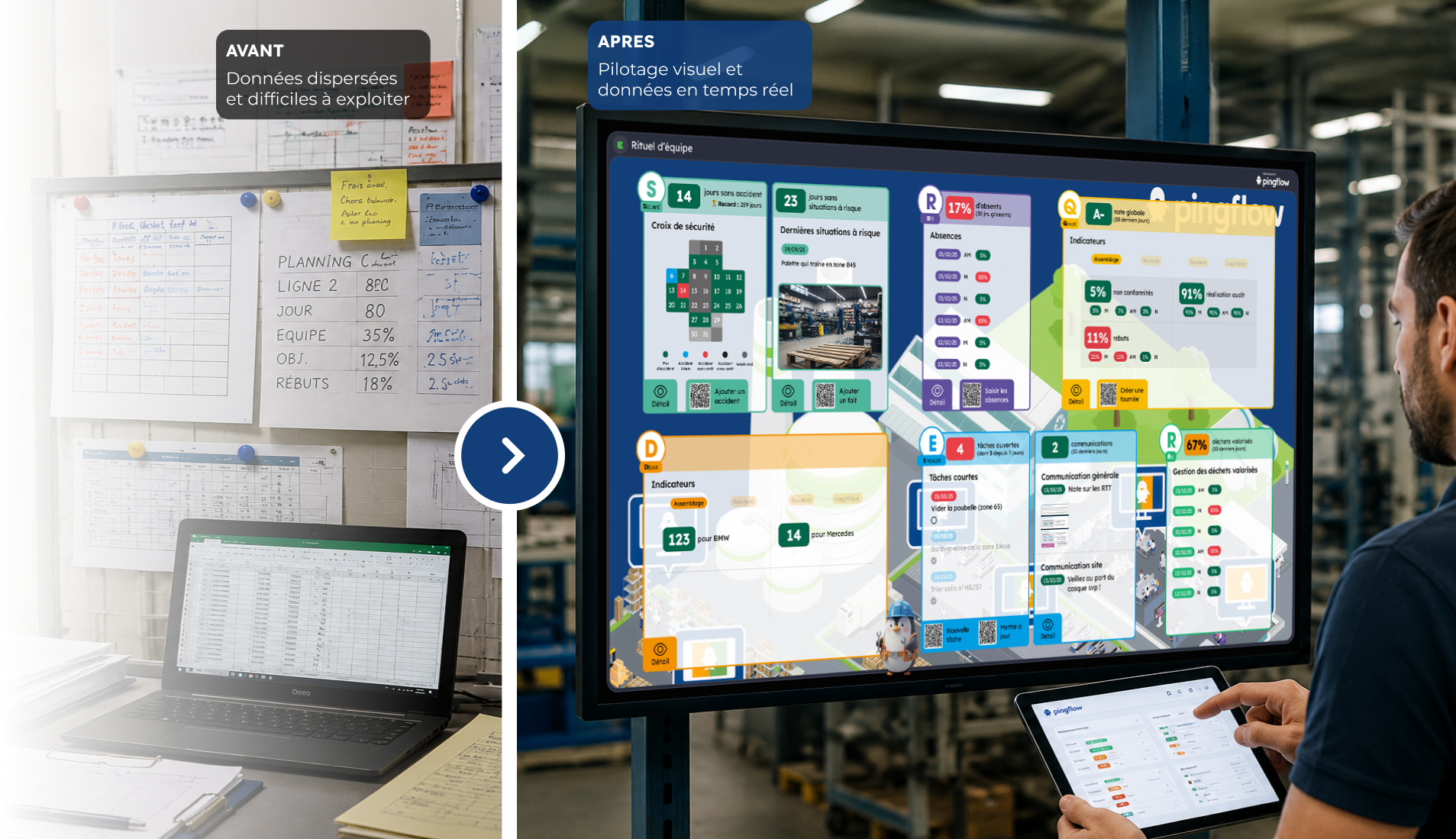
Alongside expanding the solution to new entities, Cathy Tondu and the RAYNET teams focused on streamlining the data feeding of wallboards by connecting them to Microsoft PowerBI, “to save time in displaying indicators on the screens—avoiding, for example, the generation of Excel files—and to produce clean and consistent data,” explains Cathy Tondu.
This project also provided an opportunity to create data using Table’s smart form features, our No-Code database “building block” developed with our partner Baserow.
The outcome: more effective and engaging rituals
A fast and well-established deployment
50 wallboards début 2025, un objectif de 70 en fin d'année : le déploiement du management visuel digital avance à un rythme soutenu chez ARaymond. Grâce à des processus de déploiement bien ancrés :
- An internal RAYNET support team trained by Pingflow, now capable of replicating existing screens,
- ATOMS coordinators experienced in the methodology of digital visual management projects, now capable of independently or almost independently leading projects that replicate existing screens,
- Program management at the group level with the support of business coordinators, and greater support from Pingflow for new entities to be equipped, particularly internationally (where deployments are accelerating) and for new use cases.
"This way of working allows us to accelerate: in an entity that already has a first wallboard, we can deploy a new one in 1 or 2 months," estimates Cathy Tondu. "For reasons of stakeholder availability, and to avoid disrupting production, we tend to expect 3 to 4 months when we co-build a wallboard with a new factory."
As ARaymond has more control over the design of its wallboards, Pingflow teams are called upon for innovative projects.
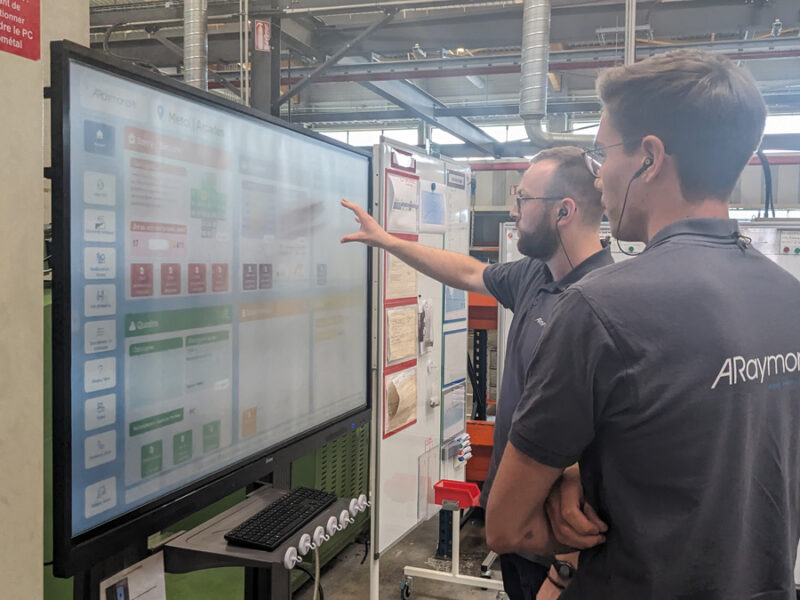

Teams conquered
Through regular surveys, ARaymond measures the satisfaction of entities equipped with wallboards, and the results are very positive:
- On the effectiveness of the rituals, with significantly reduced preparation time, fewer back-and-forths, and less paperwork…
- On the quality of the information presented during the rituals, which creates a highly valued framework of trust for all workshop staff,
- On the adoption rate: the deployment of a wallboard has a positive impact, generating curiosity and motivation.
An additional, but not insignificant, bonus: the digitalization of these visual management panels facilitates teleworking, particularly within support teams.
A fast and well-established deployment
As a sign that digital visual management is gaining momentum at ARaymond, the group is now moving towards new use cases, closer to activity management than team leadership.
- for logistics, in France, with a project aimed at monitoring activity and workloads in real time to be able to quickly adjust resources where needed,
- for production and activity monitoring, in the United States.
This is the case:
"It's on this type of new uses that we will be working in parallel with the deployment of AICs," anticipates Cathy Tondu. "It's very interesting, but like any digitalization project, it requires having thought about the organization and skills - typically here training logistics employees to be versatile." Watch this space!